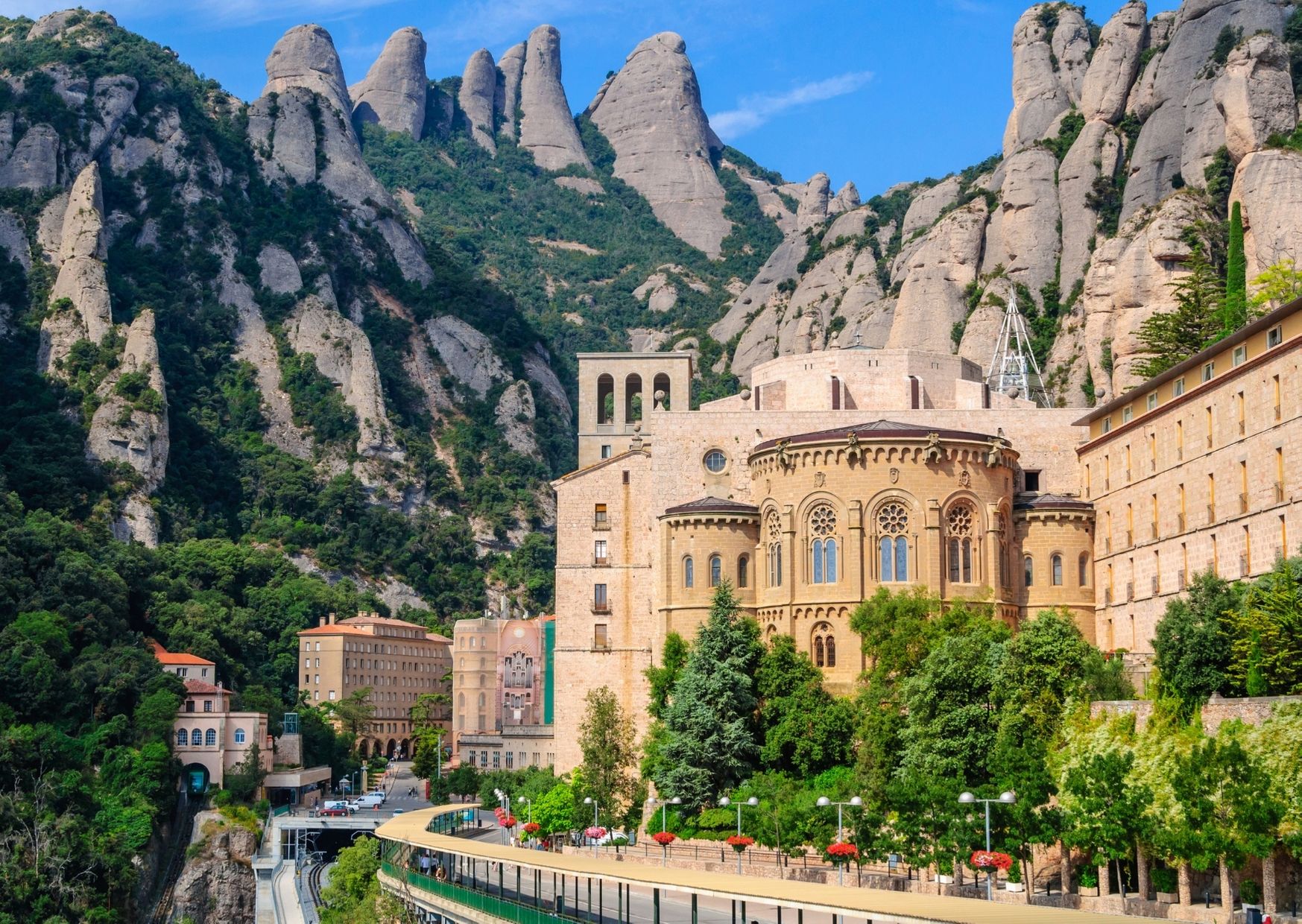
The town of Montserrat, the name a literal translation to mean “saw mountain”, is a place that will always inspire me. As a child, having lived in the coastal town of Sitges, it was a spot that me and my family would always try to visit religiously every summer, as it was only an hours drive. Each time, I come away learning something new about the town. Seeing something different. I suppose that is why Montserrat has become such a significant place to me. Located in the high mountains of Catalonia, the town overlooks the deep valleys of the national park, boasting beautiful views of pine forest. Being this close to nature was something I loved growing up, and still do.
On the mountain itself, is a large Benedictine monastery, where my parents and I would stare up at in awe every time, standing in the middle of the paved courtyard as we were. Everything looks bigger and more intimidating when you’re a child. That’s how I remember feeling when I stared up at the giant stone pillars that decorated the outside of the cathedral for the first time; hand in hand with my mother. Small and intimidated. My family and I had travelled from the busy hustle of Barcelona to visit the mountain town of Montserrat, particularly the cathedral and the religious statue known as the Black Madonna it had hidden away inside. The line to get in was so long it seemed like it would take more than the afternoon to even reach the entryway!
Once inside, large stone pillars, built from the mountain itself, formed a grand corridor of sorts, and following them down would lead you to the main altar. The ivory white cloth draped over the stone always made me think of the nearby stream back home. We were taken on a winding route that gave us a tour of the whole interior of the cathedral. Having been lead up some stairs that took us up onto an open balcony, we could gaze down into the area where the congregations would sit, as well as getting a glimpse of the altar. Following the path, we were taken around the whole of the cathedral, until we reached another set of stairs that took us into a small hidden alcove where they kept the statue. At the time it didn’t look like much, just a statue similar to all the others I had seen when going to Sunday church with my family. And it was small – much smaller than I had anticipated – the ebony carved icon was a beautiful and delicate thing, the Madonna’s face shining under the bright beams of the room’s spotlights. It had been a shock, to my young mind, that something so small could garner so much attention from the world. It has only been recently, that I have understood its relevance, through the town’s own legend of the Black Madonna.
In the year 888 the Black Madonna was discovered by shepherds in a cave – now titled Santa Cova, having been alerted to its location by large fireballs shooting from the entrance. Upon trying to move the Madonna back to their town of Manresa, however, it begin to weigh more and more. The shepherds then realized that the statue wished to remain in the mountain town of Montserrat, where it is now known through the centuries as ‘La Moreneta’, with many miracles being associated with her throughout Europe.

The cave, Santa Cova, is one of the few located in the area, with a handful of hiking trails leading up it. As a child exploring the trails, the first thing I noticed as I was hiking up the mountain, was the sheer beauty of the forest. The trees seemed to go on forever, at least to my young mind, disappearing into the horizon. As we made our way furhter up the trail, the heady scent of the pine trees was gradually replaced by much cleaner air. It had that icy feel to it, the kind that almost seemed to burn your lungs as you breathed, causing them to go numb. Despite this cold burn, I was still enthusiastic as I could see the whole of the valley, that to me was worth the slight uncomfortableness. It felt like I was standing on a parapet, the trail my group had taken had man-made steps carved into the side of the mountain, but with no railing. There was nothing between us and the sheer drop.
“As long as you stick to the inner wall, and don’t get too cocky looking over the edge,” were the words of our guide who was with us, “you’ll be fine.” Indeed, I remember clutching to my mother’s arm while I made my own cautious attempt to peer over the edge. “He was just joking” my mother had said, “just trying to tease you”. Of course he was, the steps were wide enough for two people to safely walk side by side, I had still been at the age of naivety and wonder, still trusting adults knew everything in the world – I probably would have believed anything that guide would have told me. Upon making it to the top, we had the luxury of overlooking practically the whole of Catalonia, the valley was an inspiring sight, vast forest and natural cliff faces that make up the natural park – in the distance, the view of the ocean, a tiny speck.
Another sight to visit is the museum – or Museu de Montserrat (Link included below). It is the best way to learn, not just about the history of the town, but of the areas around Catalonia. The exhibits that are displayed focus on the rich heritage of the Monastery, dating back a thousand years. The museum is open everyday from 10am – 5.45pm, and from 10am – 6.45pm (Summer Hours: June 22nd – September 15th, as well as weekends and feast days). The ticket prices for getting into the museum as also reasonable, with Adults costing €8 and Children only €4. Upcoming exhibitions for the year 2019 will consist of work created by sculptor Jordi Alcaraz (June-November), and artists Gerard Mas (November – March, 2020) and Jordi Isern (December – May, 2020).
There are several ways to get to the town itself, other than the choice of walking the 15 minutes from Monistrol de Montserrat train station, up the winding roads built into the mountain. Those visiting from Barcelona would need to take the R5 train line from Placa Espanya to Aeri de Montserrat, from there the most popular transport is the Aeri (cable cars). Located at the base, visitors get the scenic view as they are carried up on a direct trip into the heart of town. The trip is short, but sweet, lasting about five minutes until you reach the top. Allowing you the opportunity to get an eager glimpse of the surrounding valley through the tinted windows of the cable car. Once in the town itself, tourists are able to spend the day visiting all there is to see in Montserrat, before taking the cable car back down in the early evening, before they close at 7pm. There are buses that can also take you into the town from Barcelona, for those travelling independently. From Estació Sants bus station, there is a bus once per day that will take you straight to Montserrat Monastery in the early morning (09.15am), lasting one hour and 25 minutes, and will take you back to Barcelona in the evening (18.00pm).
I finally managed to take the cable cars myself eventually when I was seventeen years old. I was part of a small youth Pilgrimage group, and were making our way to Madrid for World Youth Day in 2011. We stayed in a large hostel up the side of the mountain, that had been provided especially for Pilgrims making their pit stop in the town, before continuing on their way to the capital. Unfortunately, other possibilities for accommodation won’t be found at the Monastery itself, but at the four main villages that surround the base of the mountain. The towns listed are Monistrol, El Bruc and Collbato, each one providing their own individual style. (Link to the hotel list below)
The hostel that we had stayed at consisted more of a large sports hall that had been emptied out, the large gym area had been filled with old tables and chairs and transformed into a kind of food hall. Perfect for large travelling groups to fit comfortably and socialize. I’d met many wonderful people during that trip: in particular a very friendly group from Chile. They’d sit with me and my travel companions and we would spend our nights swapping stories, playing cards – teaching eachother new tricks (It’s where I learnt to play Rummy for the first time). It was a diverse exchange, and I’d unexpectedly come away with new friends and a fresh perspective.
Link to the hotel list: https://www.montserrat-tourist-guide.com/en/hotels/cheap-hotels-in-montserrat.html
The town square, especially, is somewhere tourists can sit comfortably and people watch, admire the unique views of the valley, and enjoy the low tolling of the cathedral bells in the background. The Mercat de Montserrat (Montserrat Market), located in the Nou Barris district just on the outskirts of the town, is a great place to explore the local stalls and their produce. Opened in 1960 and designed by architects Anglada, Ribes and Gelabert, the market provides both fresh produce stalls and non-food stalls. On a more recent trip, I decided that I should explore the market stalls myself, perusing the diverse selection offered to me: fruit stalls, independent bakers, extravagant juice bars.The market itself was thriving, as it usually would be on the weekend, and I’d had to dance my way through the crowds of people just to get to the next long corridor. I had forgotten how busy it got during the summer months. Families spending their time exploring, just as I was. I’d tried a variety of samples – eventually buying myself a small container of honeycomb to bring back home, as a present to my mother.
So, if you either decide to explore the long hiking trails up the mountain side, or choose to learn more about the culture of the region, there are still many activities to pick from. Montserrat may be a small town, but it’s rich with history and tradition, swallowed up by the much larger cities that have become the usual tourist destinations. A fine place to go out of your way to visit, both with family and friends, or even for independent travel. I can say that you will not be dissapointed.


golikov1r@mail.ru
I am not sure where you’re getting your information, but good topic.
I needs to spend some time learning much more or understanding more.
Thanks for fantastic info I was looking for this info for my mission.